Sunday, September 13, 2020

Glaive: An OSR Ruleset

After repeatedly referencing the homebrew ruleset our group played with, I figured I’d best get around to posting it.

I realize that the fantasy tabletop RPG community needs another ruleset like it needs another hole in the head. Like Arnold K said on Goblin Punch:

“Everyone has a homebrew ruleset, and everyone wants to show it to other people, or at slap it around until it's presentable. But no one is interested in your fantasy heartbreaker.  This is because everyone is up to their ascending colon in retroclones and besides, they're busy writing their own. It's like trying to tell other people about your dreams.  No one cares.  Give them content, not another retroclone. I know these things, and yet here I am.”

However, I find it ironic that Arnold said that before posting his ruleset, but so many people (including myself) have found inspiration from his magic system. He seemed to assume that no-one would care, but in reality he gave ideas to many folks who read his rules system ❤️️

In the same way, I realize that few people will likely read this ruleset, and even fewer will find a table to run it. But I have it – so why not share it, right? The chance that someone might find a valuable idea here outweighs the cost.

I’ll provide a link to the full ruleset at the end of this post. First, a bit of background:


What is this ruleset?

It’s basically a combination of Ben Milton’s Knave and Arnold K’s GLOG.

The game derives its ability score system from Knave. Each ability score provides a bonus to d20 rolls equal to the ability score minus 10. For example, an ability score of 14 provides a +4 bonus to d20 rolls, while an ability score of 8 provides a -2 penalty. This modifier replaces to-hit and saving throw bonuses from character class.

From the GLOG, this system takes the use of “templates” for the first four class levels, as well as the system of “magic dice” with mishaps and dooms.

Besides these two influences, there are also nods to a dozen other systems throughout – such as usage dice from the Black Hack, Labyrinth Lord’s character sheet, mighty deeds of arms from Dungeon Crawl Classics, and magic item sale rules from 5e.


Why is it called “Glaive?”

It’s a mix of the GLOG and Knave. So, Glaive 😉

Glaives (from Handbook of Weapon Knowledge: Weaponry in Its Historical Development from the Beginning of the Middle Ages to the End of the 18th Century by Wendelin Boeheimc. 1890)


 Who should play this game?

I can think of several things that might draw you to this game:

·         If you desire an exploration-focused, rather than a combat-focused, game. This was my primary reason for designing this system. Pathfinder and D&D 5e both emphasized high-fantasy, “action-hero” style gameplay built around combat encounters. In this game, combat is swift, high-stakes, and generally undesirable (as experience comes from treasure, rather than combat). While dropping to 0 hit points is rather forgiving compared to the death rules of many retroclones (to offer the referee a chance to have the PCs be captured, rather than killed), this game is not about killing monsters. It is about acquiring treasure.

·         If you’d like magic to be dangerous and unpredictable. Another thing that irked me about modern d20 systems is the safety and reliability of magic. Spells reliably went off “as intended,” and PCs had access to so much magic that magic no longer seemed magical. This game therefore “scales back” the magic PCs have access to and, in the way of the GLOG, makes any second- or third-level spell run the risk of negative consequences. Importantly, cantrips do not exist; magic is an inherently limited resource.

·         If you desire more player options than B/X or AD&D. One of the reasons I didn’t want to play Labyrinth Lord, Basic Fantasy RPG, or Old School Essentials straight “out of the box” is because of the linear mechanical progression for player characters; in other words, all mechanical decisions are made about the character at first level. From ability scores to class templates, this system offers more ways to customize and mechanically differentiate player characters from one another, still without the overwhelm or saturation of options that come from other modern systems.

·         If you’d like to use ability checks to resolve actions. I realize ability checks are something of a controversial topic within the OSR sphere – some folks disdain them as “roll-playing,” rather than role-playing – but I personally think they’re integral to the game. In my mind, they add stakes and impartial adjudication to dangerous actions. I acknowledge that ability checks, when rolled too often and at inappropriate times, detract from the game. But when used correctly, I think they offer a streamlined way to resolve player character actions and offer twists or consequences for failure.


Where did these new ability scores come from?

Perhaps the biggest divergence this game offers from other RPG systems is the use of new ability scores. If you’re reading this, you’re likely familiar with D&D's sacred Big Six: Strength, Constitution, Dexterity, Intelligence, Wisdom, and Charisma. When designing a new rules system, I decided early on I didn’t want to stick with these.

First of all, Dexterity seemed superior to other ability scores (especially in Pathfinder or 5e). It modified AC, ranged attacks, saving throws, skills, and initiative, among other things. “Dexterity” seemed to describe a lot of things about a character – not only how quick they were, but also their overall coordination – and therefore had many mechanical benefits. Therefore, I decided to split Dexterity into two new stats: Finesse and Agility.

Secondly, Wisdom seemed to vague and ill-defined for me. It seemed to generally indicate some sort of magical aptitude, due to modifying clerical and druid spells. But it also modified Perception, and will saves. And defining the difference between Wisdom and Intelligence is a hair-splitting exercise, even if you try to explain it with tomatoes. So I split Wisdom into another two stats: Awareness and Willpower.
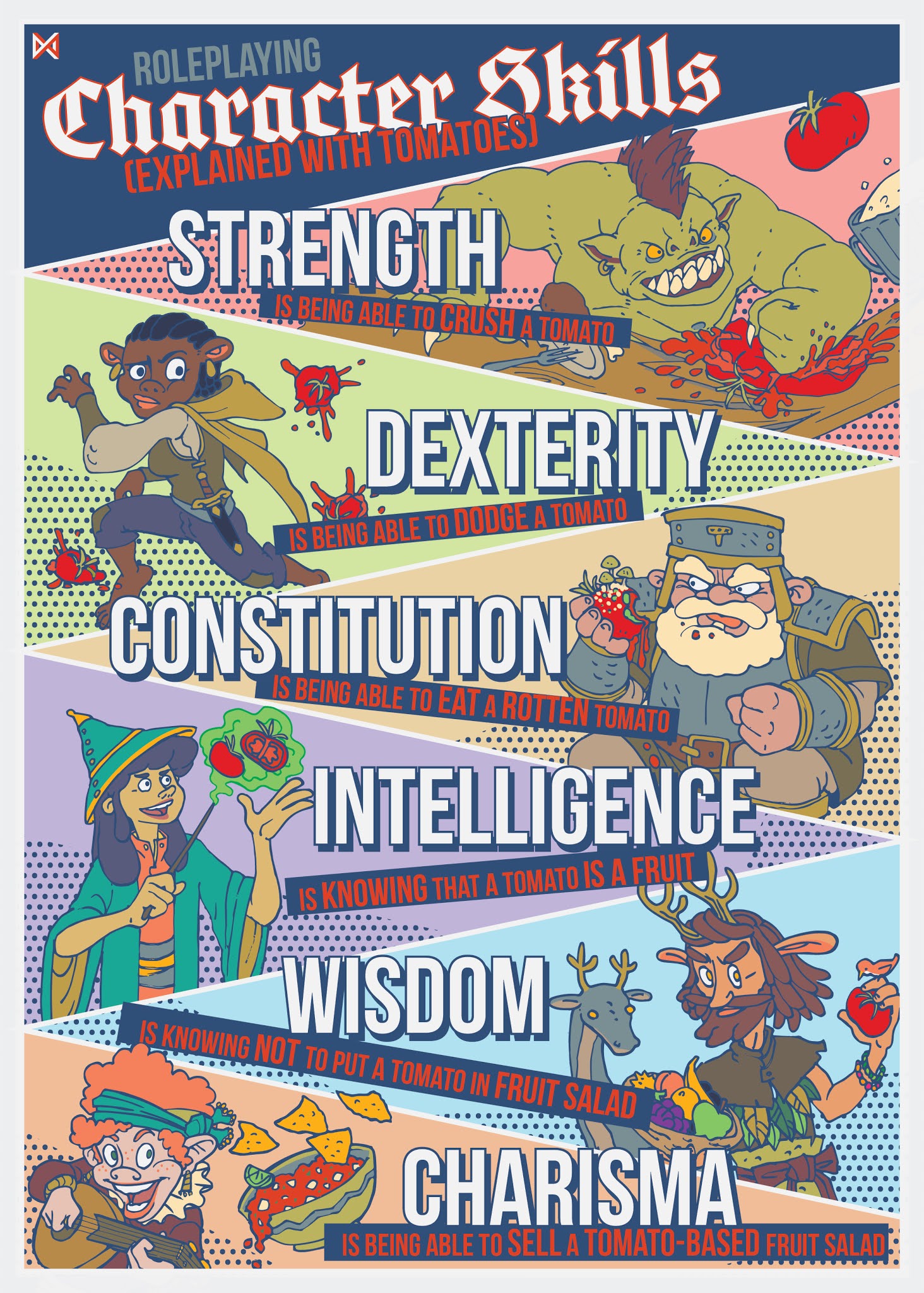
 

Early on, I decided I wanted to diverge from the standard "Big Six." Image sourced from here.

What do these new ability scores do?

Finesse governs things requiring care and precision. It covers ranged attacks and rolls made to hide, move silently, or steal things unnoticed. Agility governs things requiring speed and quickness. It covers rolls made to dodge, evade, or otherwise move nimbly. Agility also modifies defense rolls, though armor limits the bonus available from Agility.

Awareness is basically the “Perception” skill from modern d20 games, extrapolated as its own ability score. Besides finding & noticing, it also governs d20 rolls made to use divine (clerical) or primal (nature) magic. The idea is that Awareness reflects a broader “attunement” to the world at large.

Willpower is the “defensive” aspect of Wisdom, used for what would typically be Will saves in Pathfinder or 3e. It’s used to defend against mind-affecting spells. A character’s Willpower also affects the amount of magic dice they have; a character’s maximum number of magic dice per day is equal to their Willpower bonus. This means spellcasting characters will want to invest in their spellcasting stat (either Intelligence or Awareness) and Willpower.

Side note: I developed the idea to make Awareness its own stat last year, but recently saw Perception as its own stat in Low FantasyGaming just a month ago. Funny how things like that happen 😂


Is there anything else I should know if I plan to use this rules system?

First of all, you need an old-school treasure table and monster manual to run it. I would recommend the free ones from Labyrinth Lord or Basic Fantasy RPG, or the one from Old School Essentials if you have it. Any of those would work. The bestiary from Low Fantasy Gaming would also be good. Since it gives ability scores to the creatures, it allows for more differentiation than Knave’s approach of giving each creature a Target Number of 10 + HD.

Secondly, this game is not “balanced.” Though the system works well within itself, I make no guarantees that class abilities and spells are “balanced” against one another. If there are players in your group who care about min-maxing, character builds, and “exploits,” they will probably find something to take advantage of. So just be mindful of that. This game is not designed with that kind of play in mind.

Thirdly, just let me know how it goes. I’d be excited to hear that someone actually uses this rules system. I certainly enjoy playing with it, and I hope you experience the same if you find a table willing to give this a shot 😊

Here’s acknowledgements for many of the rules systems I read as inspiration for this one:

  • ·        Maze Rats and Knave
  • ·         GLOG
  • ·         Rats on Sticks / Many Rats on Sticks
  • ·         The Black Hack
  • ·         Dungeon Crawl Classics
  • ·         Old School Essentials
  • ·         Labyrinth Lord
  • ·         Basic Fantasy RPG
  • ·         Dungeons & Dragons 5e
  • ·         Pathfinder

       And last but not least, the rules system itself. Enjoy! ✌️


Sunday, September 6, 2020

The Secret Doors of Dyson's Delve

Recently, I got the urge to run Dyson’s Delve, a (graciously) free-to-download “Mini Mega-dungeon” available on Dyson Logos’ blog.

For a free adventure, Dyson’s Delve is excellent. Heck, it would be great even if you had to pay for it. It’s got all the things on Arnold K’s Dungeon Checklist, as far as I can tell.

The first level of Dyson's Delve, and an excellent example of Dyson Logos' stellar mapmaking skills.


As great as Dyson’s Delve is, a bit of work I’m doing to run it involves “filling in” the secret doors in the dungeon. Most of the secret doors on the map receive little attention in the text with regards to how they are hidden or how they operate.

Mind you, this is hardly a complaint. You can’t really complain about a free adventure, in my opinion. But, as I’m spending time to think through & flesh out these secret doors, I figured I would share my work. Perhaps it will save other referees the time and energy.

So, here it goes: a description of each secret door in Dyson’s Delve. And obviously, if you’re a player in one of my games or will be a player in Dyson’s Delve, you probably shouldn’t read this.

*I also should add that, although there is a distinction between secret doors and concealed doors, I treat them as one and the same for the purposes of this dungeon.

THE SECRET DOORS OF DYSON'S DELVE

Level 2, between Areas 3 & 4: This is actually a normal wooden door blocked with furniture and barrels on the west side by the goblins (to prevent creatures passing through from #4).

·         A casual inspection on the west side reveals only the furniture and barrels stacked against the wall, though anyone who inspects the pile closely will notice the door behind them. The clutter can be moved aside with a few minutes of careful work.

·         If characters attempt to pass through the door from the east to the west while the furniture remains, treat the door as if it were stuck. Knocking over the clutter in haste will inevitably make much noise, necessitating a random encounter check.


Level 3, between Areas 2 & 3: Each of the alcoves in this wall contains several burial niches. Some are empty. Some have corpses. Some of the corpses are ghouls. (Think of the resting place of the draugr in Skyrim). In the alcove marked with a secret door, the bottommost burial niche has no back wall. Instead, a tunnel passes through to room 3.

·         Standing characters will not notice this tunnel with a casual inspection; only characters who bend down to search the niche will notice the bottommost one has no wall behind it.

·         Passing through the tunnel requires crawling on hands and knees, as it is only 2ft tall and 6ft wide. Characters may also have to remove their backpacks (if they wear them).

My inspiration for the secret door above. I'm imagining a wall lined with several burial niches, as in Skyrim. Image source here.


Three Secret Doors on Level 4: This series of secret doors is used by the lizard men to prey on the goblins and remain hidden from the manticores. This means the doors must be well-hidden and discreet to use.

My idea is to change these secret “doors” into secret trapdoors. In other words, rather than secret doors in the wall, these are secret doors in the floor. And, rather than being part of the dungeon’s initial construction, rooms 9, 10, and 13 are actually tunnels dug by the lizardfolk underneath Level 4.

Therefore rooms 11, 12, and 8 each have large flagstones on the floor. The lizardfolk have “hollowed out” sections underneath the flagstones, allowing them to be raised up and pushed aside to allow passage through (like a manhole cover).

When the lizardfolk prepare to exit, they carefully raise the flagstone and peek out to see if the “coast is clear.” If so, they lift the flagstone entirely and crawl out, then carefully replace it before conducting their raid. Once finished, they return and disappear back down the whole, with one lizardfolk always carefully keeping watch.

Finding these secret tunnels is quite difficult, as the lizardfolk are very clever. Only those who purposefully inspect the floors in rooms 11, 12, or 8 will notice a single tile in each room lacks grout or mortar around it. If you’d like to be a generous referee, you may also say characters have a chance to notice dirt or mud lizard-prints somewhere in the dungeon, perhaps leading to a corner of the room, but disappearing.

Furthermore, lifting the flagstone with bare hands is quite difficult. A tool like a crowbar is necessary to raise it (which the lizardfolk possess).

Characters who carefully listen while on this level (or spend much time here, such as by resting) may hear the lizardfolk emerge from their tunnels (though they try to be quiet about it). Characters who quietly rest or wait in rooms 11, 12, or 8 may even catch a glimpse of a lizardfolk carefully lifting a floor tile to peek out, though any lizardfolk who see a character will quickly try to conceal their presence. The lizardfolk will fight to the death to protect their tunnels and their lair in room 13.


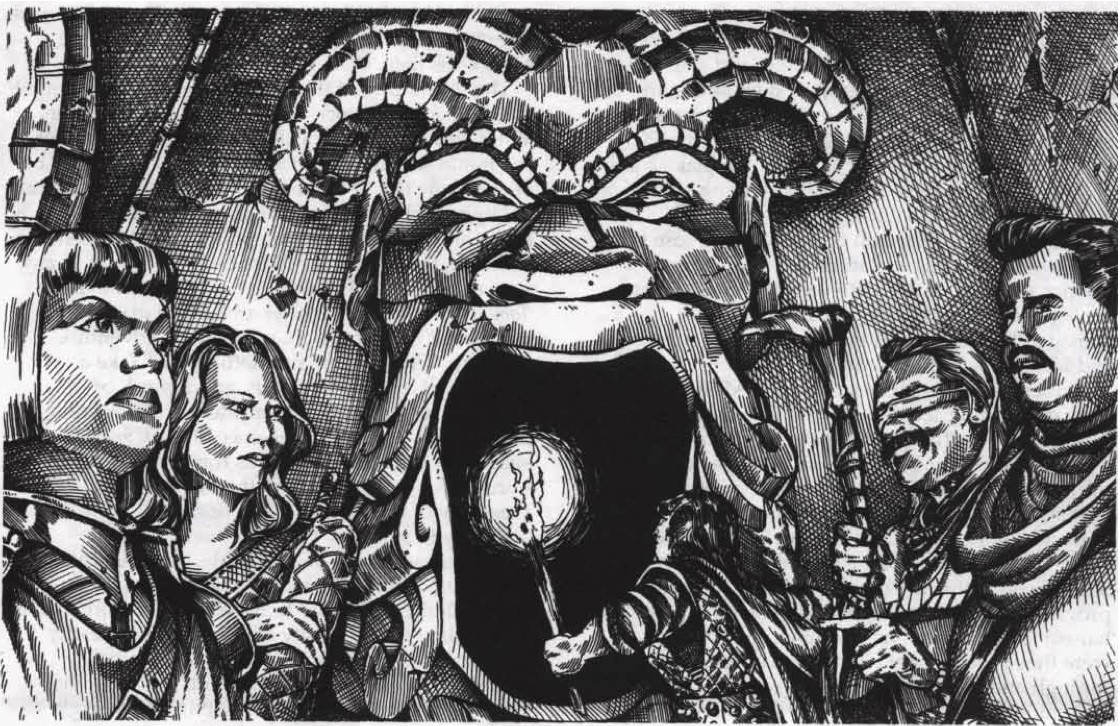
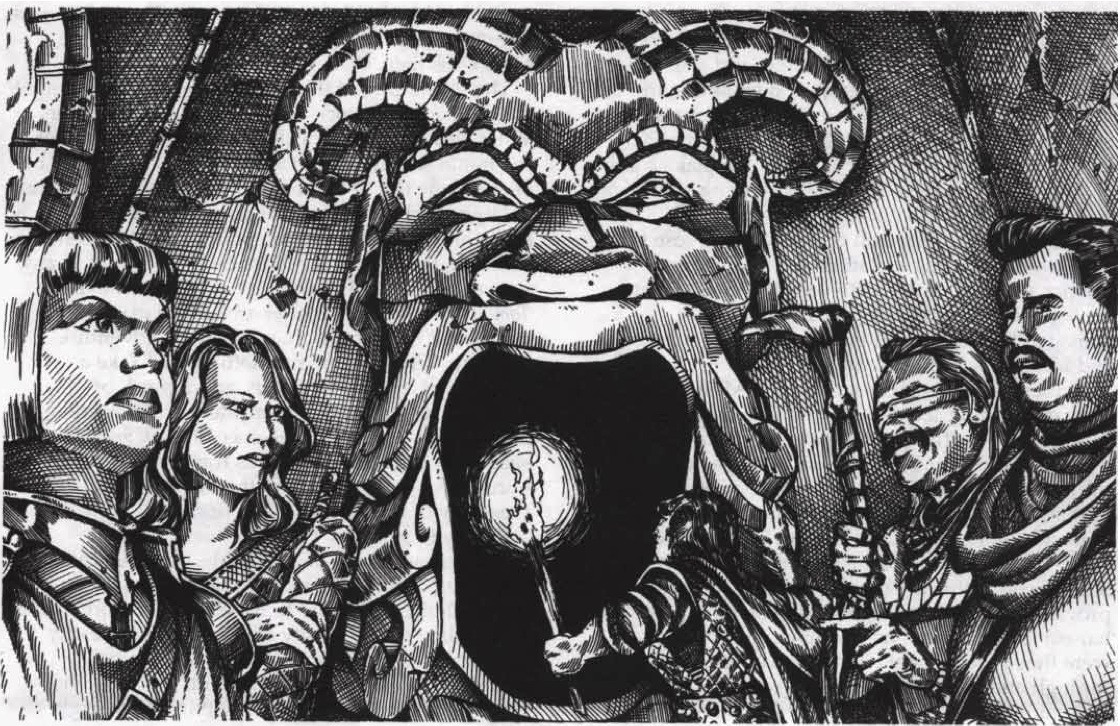
Level 6, between Area 12 to Area 4: Each side of the wall in these locations bears a carved green gargoyle face with a gaping mouth ~4ft in diameter. The mouth is filled with complete darkness that absorbs all light (as per the darkness spell), which conceals a tunnel passing through the wall to the other side.

Air passes through the gargoyle’s mouth, as well as noises from the other side of the wall (if any).

Get the reference?

Level 9, between Areas 1 & 2: Room #1 possesses victims of the cockatrices’ petrification. The door to room 2 is a normal wooden door that swings inward to room 1. The troglodytes block the door with a petrified giant scorpion, which prevents the door from being opened without moving the statue. Each time they wish to enter room 2, the troglodytes move the scorpion aside. The scorpion, made entirely of stone, weighs approximately 1000lbs.

·         Characters with a combined Strength score of 33 or higher can drag the scorpion across the floor, allowing the door to be opened at the expense of making noise and necessitating a random encounter check.

·         Characters with a combined Strength score of 67 or higher can lift the scorpion off the floor sufficiently to prevent it from making noise, when moved.

·         Characters on this level may hear the troglodytes grunt and scrape while moving the scorpion statue to get inside #2. Similarly, characters who leave and return to this room may notice the scorpion statue having moved, freeing the door. In this case, a squad of troglodytes will be resting inside #2.


Level 9, between Areas 13 & 15: The wererats have placed a pair of large, sagging bookshelves here to block a hole in the wall that leads to the lair of the Caecilia. The books are invariably water-damaged and moldering.

·         Investigation of the bookshelves will notice cold air passing from behind them. Light brought close to the bookshelves reveals a cavern beyond the thin gap between them.

·         The bookshelves can be quickly dissembled, at the expense of making a lot of noise. Besides necessitating a random encounter check, this noise will also wake the Caecilia.

·         The bookshelves can be carefully and quietly dissembled at the expense of time and all the costs that incurs (ex. dwindling torches)


And that is all the secret doors in Dyson’s Delve! I hope this was helpful for you 👍 Best of luck in your adventures there.

Sunday, August 30, 2020

Coins, Weight, and Encumbrance

*Edit: What is up with all these major content creators discussing topics right before I do? 😂 I wrote this post two weeks ago, but then Ben Milton from Questing Beast made a video on Encumbrance here. Anyway, his video is really good and you should check it out.*

Encumbrance: you either use it or you don’t.

And among those tables that do use encumbrance, it seems like there are as many variant encumbrance systems as there are gaming tables.

In this article, I think through the problem of encumbrance and offer my two copper pieces on it. You can decide for yourself whether to count them as part of your inventory or not 😉


Encumbrance is one of those things I always felt like I should be tracking as a referee… but never really managed to do. In high school and college, we largely ignored it.

As I gained experience, I tried going by-the-book. I resented the finicky, large-number math that came from totaling up lots of incidental item weights. I could tell that most of my players resented it, too. I started to experiment with some variant encumbrance rules for 5e and Pathfinder, but nothing ever really seemed to stick.

Eventually, encumbrance came to the forefront of my mind during our Dolmenwood game. We decided to use advancement based on “Treasure for XP,” at which point the amount of treasure the PCs could reasonably carry became very relevant. Exactly how much was a reasonable amount of gold to fit in a backpack?

Fortunately, I wasn’t the first person to ask this question. A lot of people, much more literate in math than I, already did work to figure this out.

Ipsimus Arcanus at the Dungeon Master’s Workshop did some work to figure out what gold, silver, and copper coins would look like in real life (assuming these precious metals have the same density in your fantasy world as they do in real life).

According to Arcanus, assuming all denominations of coin are 50 coins to a pound, gold coins would be about three-quarters of an inch in diameter and 1/16th of an inch thick. Copper and silver coins would each be the same thickness and be slightly more than an inch in diameter.

And Arcanus points out in this same article how laughably outlandish the idea of a bathtub-sized pirate chest of treasure is, given these assumptions. Such a chest would hold almost 680,000 gold coins and weigh six imperial tons!

Reading Arcanus’ article really put things into perspective for me. I realized exactly how absurd it was for a PC to carry around thousands of coins without difficulty.

And I realize it's a fantasy game about dragons and magic – it’s not exactly realistic – and if that’s the kind of game you want to run, good on you! For myself, I wanted to play a game that was intentionally fantastical – not conveniently so.

Note that the above calculations use the 5th edition assumption of 50 coins to a pound. B/X D&D instead operates with the assumption of 10 coins to a pound, which creates coins approximately the size of a U.S. silver dollar (as described here on the Blog of Holding). Personally, I prefer the idea of 50 coins to a pound much more. It seems more “grounded.”

A bit more about old-school encumbrance: Old School Essentials (my reference point for B/X D&D), encumbrance is presented as an optional rule. OSE says that, if encumbrance is used, the amount of treasure a PC carries should always be tracked. OSE uses “coins” as a unit to determine encumbrance; every piece of equipment has its encumbrance value listed in coins. With regards to equipment, there are two ways to track it.

The first option ignores the weight of armor, weapons, and gear. PCs simply alter their movement speed dependent on 1. the armor they wear and 2. if the referee says they are carrying “a significant amount of treasure.”

The second option counts the weight of armor and weapons individually. Miscellaneous adventuring gear is typically counted as 80 coin weight. The characters then alter their movement rate based on the total weight of the treasure, weapons, and armor they carry.

Regardless of the option used, a PC can never move while carrying more than 1600 coins.

It's notable that encumbrance has little other mechanical effect that movement rate. Obviously, the referee would be within their rights to include other effects, as necessary. But encumbrance doesn't penalize attack rolls or saving throws, rules-as-written. 

I bring all of this up to emphasize how, in B/X D&D, the entire point of encumbrance was to moderate how much treasure the PCs could carry. In each of the rules variants above, the thing that gets measured with the most granularity is the treasure the PCs find. Hell - encumbrance itself is even measured in “coins,” rather than pounds.

In my mind, encumbrance likely diminished in importance at gaming tables once treasure no longer provided the primary means of advancement. When “gold for XP” became “combat for XP,” counting how much stuff you carried became much less important. And I'm not the only one who thinks this - Jospeh Mohr suggested something similar in his post here.

Furthermore – but perhaps less importantly – I also think the diminishing importance of encumbrance happened alongside an increase in the abilities of players. Once light became a cantrip player characters could cast an unlimited number of times per day, the number of torches or amount of oil you carried didn’t matter as much.

Really, encumbrance and inventory systems belong in a game about careful resource management and exploration (such as old-school D&D), not games about action heroes going around and beating up bad guys.

As another tangential thought, I wanted to add that encumbrance (and counting coins) makes gems and jewelry that much more important. When you actually care about how much coins weigh, they become one of the least efficient ways to carry treasure. Gems and jewelry are much more “value-dense,” by comparison. And that invites you (as the referee) to include other, more interesting forms of treasure for players to find and claim.

///

So, you’ve decided you want to track encumbrance. How should you do it?

I don’t know. It probably depends on the rules system you use and your personal preference.

The system I use presently use is this:

·         Provided they have a backpack, each PC possesses a number of Slots equal to their Strength score. PCs without a backpack have half as many slots.

·         Most items take up one Slot. Especially heavy or bulky items may occupy more, at the referee’s discretion. Light armor takes one, medium armor two, and heavy armor three.

·         Small items (ex. torches, scrolls, rations) may be bundled into groups of 3 to a slot. (You could do 5 to a slot, if you’re feeling generous).

·         A Slot holds up to 250 coins.

·         Incidental items (ex. a base layer of clothes, jewelry, gems) do not occupy a slot unless carried in large quantities.

For characters who carry more Slots of stuff than they have available, I use a variant of 5e encumbrance. If you carry more stuff than you have available slots, you are encumbered, which means your speed is halved and you have disadvantage on any d20 roll using Strength or Dexterity. Carrying stuff occupying than twice the number of Slots you have overburdens you, which means you automatically fail those rolls and can’t move.

Furthermore, I also use a “silver standard” as described at Delta’s D&D Hotspot. Essentially, I take all treasure values listed in OSE/LL and either 1. divide them by 10 or 2. move them to the next-lowest denomination (ex. changing silver to copper). I convert currency as 1 gold = 10 silver = 100 copper. We count XP in terms of silver pieces acquired, not gold pieces.

This basically allows me to award the same “value” of treasure with much less physical space for player characters. Fifty gold coins in a silver standard gives them the same XP as 500 gold coins rules-as-written.

It creates a very different feel for the game, when finding a few gold pieces is a big deal. It’s a sort of “pulpy” thing I really like.

Anyway, that’s all I have to say about encumbrance. I hope reading all of this wasn’t too much of a burden 😉

Sunday, August 23, 2020

Kidnap the Archpriest: Review

BACKGROUND & SUMMARY

The players are adventurers hired to Kidnap the Archpriest. They’ve got to get into his castle, nab the old man, get out, and get paid.

This “heist-style” adventure is divided into three main parts: developing the plan, capturing the Archpriest, and trying to get away. Among the resources included are a map and description of “fantasy Rome,” a keyed map of the castle, write-ups and timetables for each major NPC, and some advice for designing your own heists.

This adventure was written by Skerples of Coins and Scrolls, whom I’ve mentioned in reverence several times on this blog – particularly for the Tomb of the Serpent King. Since I’m writing a review of Skerples’ work, perhaps Skerples will read this post? In which case, I’ll likely freak out and faint on my computer like a fan girl.


Upon writing this review, I’ve run this adventure twice: once as part of an ongoing campaign and once for another group as a standalone adventure. Also, this review contains spoilers. You probably shouldn’t read it if you plan on kidnapping the archpriest yourself.

GOOD THINGS

The writing is compact and punchy. It describes exactly what you need to know to evoke locations and voice NPCs. There’s few wasted words and nothing glaringly missing.

In the same vein, this adventure seems designed with “ease of use” in mind. Entries in the castle key have pull-out maps on each page, so you can see what’s described. Advice for the referee is solid and written in conversational style. The adventure itself is well-formatted, with info contained to single pages and few bleed-overs.

The NPCs are flavorful. There’s intrigue, deception, and conflict ripe for exploitation.

Overall, the adventure is fun. As you’re reading, you can sense the impending fun (and chaos – but the fun kind of chaos) waiting to happen.

I also think it’s important to recognize the adventure’s originality. I’ve never read or played another adventure like it. And the “fresh air” this adventure brings is definitely a good thing about it. The novelty will likely bring joy to your players… unless you’re already playing a game that features heists all the time? But who does that?

I also appreciate the advice Skerples provided at the end about creating your own heists. I think heists are an under-utilized genre of adventure and would love to see more of them. Two thumbs up for creativity and innovation 👍👍

Across two independent playthroughs, both groups of players arrived at the same plan: to incapacitate the Archpriest and carry him out like a sack of potatoes. See above

CRITIQUES

Despite all the tools Skerples provides for ease-of-use, I still found this adventure incredibly challenging to run.

Part of this challenge may lie in my weaknesses as a referee. I tend to consider myself “good” at running dungeon crawls and wilderness exploration. However, I struggle with voicing NPCs, evoking cities, and managing lots of information at once.

This adventure involves all those things I’m bad at.

I think another part of this challenge comes from the sheer complexity of the adventure. This adventure has more for the referee to “keep track of” than other adventures. It’s generally well-formatted and well-organized information… but it’s still a lot of information.

For example, the Castle St. Logan isn’t your typical keyed map. It’s a map whose contents change every hour of every in-game day, meaning you must constantly refer to the text to see what’s in each room AND cross-reference that entry with the in-game time. This addition may not seem like that big of a difference, but it really seemed to compound on itself during play – particularly when trying to figure out who might be in adjacent rooms and react when the PCs inevitably did something stupid.

The keyed map of Castle St. Logan made this process harder to do “on the fly” because it lists each NPC that might be in the room, followed by the times they might be there. In my opinion, it’d be better to give a list of timespans in the room, then the occupants of the room during each timespan. While running the game, I’m don't scan the map to find a specific name - I can look on a specific NPC's timetable, should I need to find them. When I'm looking at the map, I’m looking to see who’s in each room at the present time. This change would keep me from having to scan each NPC’s entry for the present time; instead, I could read the current time and see which NPC’s are there. Perhaps there’s a compelling reason the info’s not already organized this way (i.e. it could take up more space on the page), but it’s something that might have made running the adventure easier.

With regards to the complexity of this adventure: if you choose to purchase and run it, I advise you to diligently prepare for it. When you think you’ve prepared, keep preparing until you’ve over-prepared. It could just be my own incompetence, but I don’t perceive this as an adventure you can effectively “pick up and play” the same day. To run it well, I think you need to read it in advance more than once and develop diligent notes. I made mistakes while running it both times (which detracted from the experience and made the adventure more difficult), despite all the studying I did beforehand.

Furthermore, during your preparation, be sure to take your campaign setting and rules system into account. I’ve seen other reviews suggest this module can be used with any system or campaign setting, which is perhaps a bit misleading. It’s true you can adapt this module to any system, but Skerples directly states in the text, “This module isn’t about spellcasting clerics.”

It makes a big difference whether the archpriest is a defenseless old man or a 12th-level cleric in B/X D&D. Fifth Edition makes magic an even greater concern. Access to spells (ex. alarm, zone of truth, disguise self, fly, invisibility) and magic items would drastically change the castle’s defenses and require significant adaptation. Skerples concurs in the text, stating that the referee needs to add defenses to the castle to accommodate the system – and I think this point is worth emphasizing for any potential buyer, as the low-magic setting means this adventure takes more work to “drop” into an existing campaign with more magic. Perhaps the simple (but cheap) work-around would be to say that the castle is surrounded by an anti-magic field? I suppose that saves you prep time as a referee, at the expense of feeling like a cop-out.

FINAL & FORWARD-THINKING THOUGHTS

Acknowledging the challenges I faced, I started to think about the tools I needed to help me run it more effectively. Exactly what problems did I have? What could I do to alleviate them? If I ran this adventure a third time, what would I do to help me have an easier time of it?

After running it the first time, one ease-of-use tool I made for myself was a single-page keyed map for each level of the Castle. I’ve included an image of a level below, with some text intentionally omitted to protect Skerples’ copyright. The adventure already included room descriptions next to zoomed-in pull-outs of each level, such that maps and descriptions of levels 1 and 2 are spread across three pages each (six pages total). The first time I ran the adventure, I found myself interrupting the tension of the heist by page-flipping and cross-referencing as the PCs moved from room to room.

The one-page labelled map came in handy the second time I ran the adventure and seems like something that would be beneficial for future heists. Even the simple arrows connecting the descriptions to the rooms themselves saved me a few seconds from scanning down the numbered entries. Those seconds really seem to matter at the table. There might be a reason such a map wasn’t included in the official product, but it’s something I’d recommend to a referee planning to run the adventure.

Along that same line of thinking, I like the idea of exploring new and innovative ways to present the information about the heist. A heist will inevitably be a complex and interwoven adventure, I think. However, given that the heist is a fundamentally different type of adventure from a traditional location- or event-based adventure, I’m wondering if there are other ways to present the information that may better suit this adventure style? One thought that comes to mind would be an NPC map, like the one below provided for a one-page dungeon submitted to the contest in 2012.

"A Rough Night at the Dog & Bastard" by Kelvin Green

There’s also the above NPC map provided in Woodfall by Lazy Litches Loot, which could be an interesting way to organize the information about the Cardinals or denizens of the Sober Monk Inn. For example, Cardinal Delver has an illegitimate son named Thormund. However, this information is listed only in Thormund’s description – not Cardinal Delver’s.

Skerples provides an “NPC Summary” on page 28, but I got little use from it because it only includes roleplaying cues for the NPCs. A single-page reference sheet with more information about them would be helpful. I’m imagining a chart with NPC names along the top and rows of consistent information about each: their persona, reasons to help the PCs, reasons to oppose the PCs, the help they could provide, and the hindrances they could introduce. I'd make such a sheet for myself, were I to run it again.

The same thing could be done for entrances to the castle. The columns could list four ways into the castle (ex. Main Gate, Side Gate, Covered Bridge, Climbing the Walls), and rows could list what activity PCs observe at each, the entrance's weaknesses, and the entrance's defenses.

To be clear, I’m not saying I necessarily expected this adventure to include any of these things. These methods of organizing and presenting information aren't standard. They might only benefit someone as incompetent as myself.

However, reading and running this adventure has me thinking about – and questioning – the standard, “conventional” ways of presenting information in adventures. And I’m wondering if the "traditional" ways of presenting information in adventures are the most relevant and useful ways to present information for heists. It seems to me like this new kind of adventure could result in some new kinds of information management for referees.

CONCLUSION: ⭐️⭐️⭐️⭐️⭐️/5 Stars

Definitely worth the $5 price tag on DriveThruRPG. Even if you never get a chance to run it, it’s worth reading simply to appreciate and learn from its design. If you do run it, read it through several times in advance and adapt the adventure for your chosen system. It’s written for a very low-magic setting and needs some thought to make sense for a setting with spellcasting clerics. If you’re like me, it will significantly challenge you as a referee. It’s not an easy adventure to run, but worth the time and energy to do so because it’s fun, original, and unique.